1998–1999
NATO at fifty
By NATO’s fiftieth anniversary, a proposal to let former adversaries learn together had reached heads of government. In Sweden, officers and civilian officials would put it to work in the VIKING exercise.
Secretary Cohen at the Brussels ministerial
On June 12, 1998, at NATO headquarters in Brussels, U.S. Secretary of Defense William S. Cohen addressed the defence ministers of the Euro-Atlantic Partnership Council. His subject was what the Partnership for Peace could offer countries with very different ambitions. A country could seek NATO membership, or it could choose a lasting partnership on its own terms. Both could help shape European security. Cohen called for “a cooperative security network of Allies and Partners.”
The proposal gave civilian universities and independent scholars a place alongside the defense academies. Participating countries could decide for themselves what to study and how to run the Consortium.
Cohen and German Defense Minister Volker Rühe offered the Marshall Center as interim secretariat. Switzerland hosted the first Consortium conference in Zürich that October. By December the ministers in Brussels were hearing both the report from Zürich and a briefing on the proposed simulation network.
The fiftieth-anniversary summit in Washington
Walter was the principal architect of the Partnership for Peace Training and Education Enhancement Programme (TEEP). The three parts he helped bring together answered different questions. Who could develop and teach the material? Where could people from several countries train? How could they practice making decisions together while working in different places?
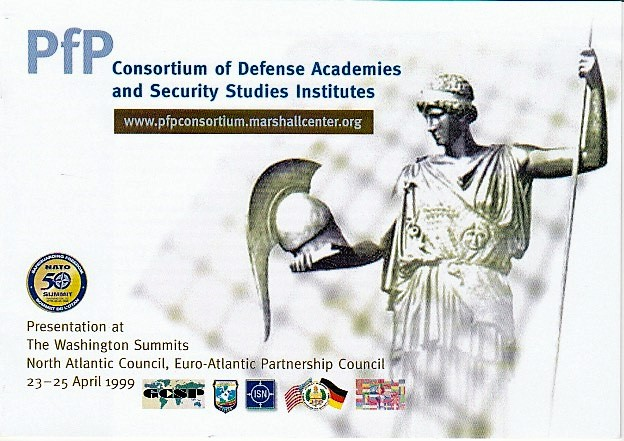
On April 24, 1999, NATO leaders meeting in Washington endorsed the outline for training and education. Paragraph 25 of their communiqué named the PfP Consortium of Defence Academies and Security Studies Institutes, the PfP Exercise Simulation Network and PfP Training Centres. The leaders then instructed the North Atlantic Council in Permanent Session to develop the full TEEP.
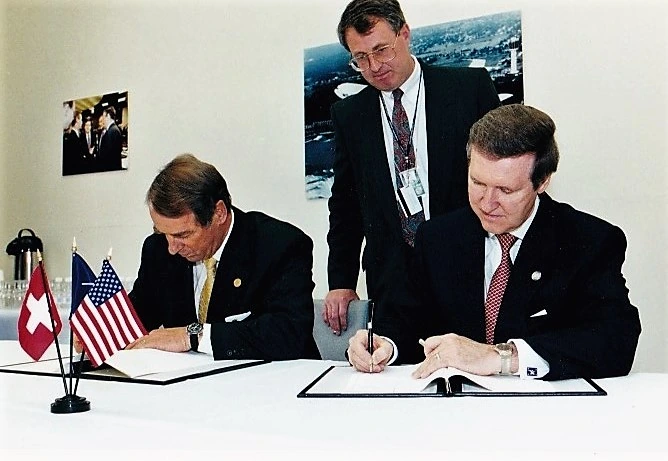
Walter and Theodor “Teddy” Winkler negotiated the agreement that Secretary Cohen and Swiss Federal Councillor Adolf Ogi signed the following day. It committed the two countries to developing an online library where defense academies could share courses.
What the Consortium let partners do
For a teacher in a newly democratic country, the arrangement offered a way to put a difficult question to colleagues abroad. A civilian researcher and a staff-college instructor could join a working group, compare how their countries handled civilian oversight, develop teaching material and take it back into their own classrooms. Annual meetings, a journal and shared online resources gave the work continuity.
With a shared course library, a teacher at one academy could pass a lesson to colleagues abroad without waiting for the next annual meeting.
The same principle applied to the training centres. Each country could teach something it knew particularly well and invite partners to learn there. In his tenth-anniversary essay on the Consortium, Walter called this a community of experts. The useful relationships were the ones that survived the conference.
Greg Knapp, Ulf Jinnestrand and the choice of VIKING
Walter asked Major General Marty Berndt whether U.S. Joint Forces Command could support an exercise held in several places at once. Berndt said it could and directed him to Greg Knapp. In Sweden, Walter and Greg met Ulf Jinnestrand and the Swedish simulation team. Walter put a practical question to Greg. Could this team make a multinational exercise work across sites? Greg thought they could.
Walter wanted the demonstration planned for the anniversary summit to lead to an exercise people would actually use. He asked how long the Swedish team would need. They showed him their exercise schedule. In Walter’s words, “I chose VIKING.” Sweden would lead and the United States would support it.
The demonstration took place at the Washington summit. Later that year VIKING 99 put the PfP Simulation Network to work in a Swedish-led multinational peace-support exercise. People in different countries took part in the same unfolding scenario. Later exercises brought military staffs, civilian authorities and humanitarian organizations together.

Sources and recollections
- The Apocalypse of Assumptions, Book I of The Age of Convergence, chapter 14, “De Oppresso Liber,” p. 212.
- Empowering Change, Book III of The Age of Convergence, chapter 2, “From Spectator to Participant,” pp. 23–25.
- Making Partners of Adversaries, chapters 7–9, on the Consortium, the Swedish team and national training centres.
- Secretary William S. Cohen’s ministerial remarks, reproduced in Connections, vol. 7, no. 3, pp. 77–80.