1992–1996
The Marshall legacy
A student award at Duke, a school for former adversaries and a presidential invitation all bore the same name. Each time, George Marshall’s legacy asked something different of Walter.
A school for former adversaries
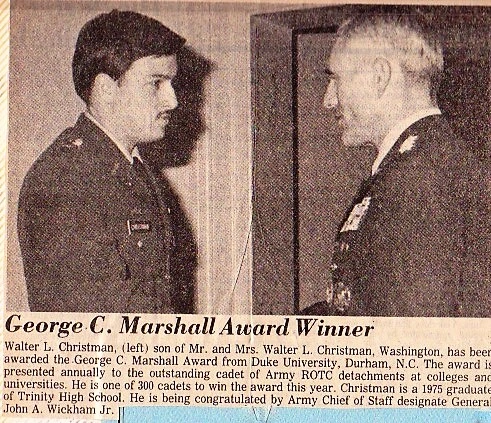
At Duke in 1983, General John A. Wickham Jr. congratulated Walter on the George C. Marshall Award. Less than a decade later, Romanian parliamentarians asked the young Pentagon official how civilians could exercise their newly won authority over a military budget. Where could a legislator learn to question a general, and where could the two learn together?
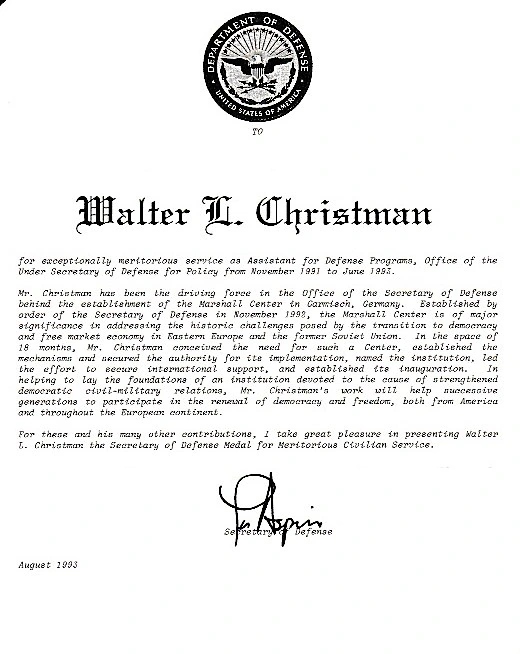
Walter proposed a school and named it for the general who had helped Europe rebuild. Secretary of Defense Dick Cheney authorized the George C. Marshall European Center for Security Studies in November 1992. On June 5, 1993, U.S. Secretary of Defense Les Aspin and German Defense Minister Volker Rühe inaugurated it in Garmisch-Partenkirchen. A bilateral agreement followed in December 1994. Walter’s 1993 civilian-service citation records his work conceiving and naming the Center and obtaining the authority to establish it.
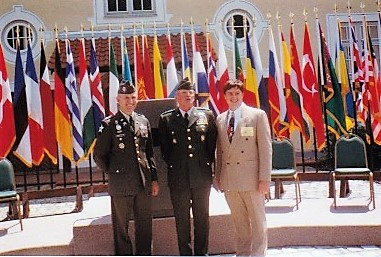
Trustees of the George C. Marshall Foundation
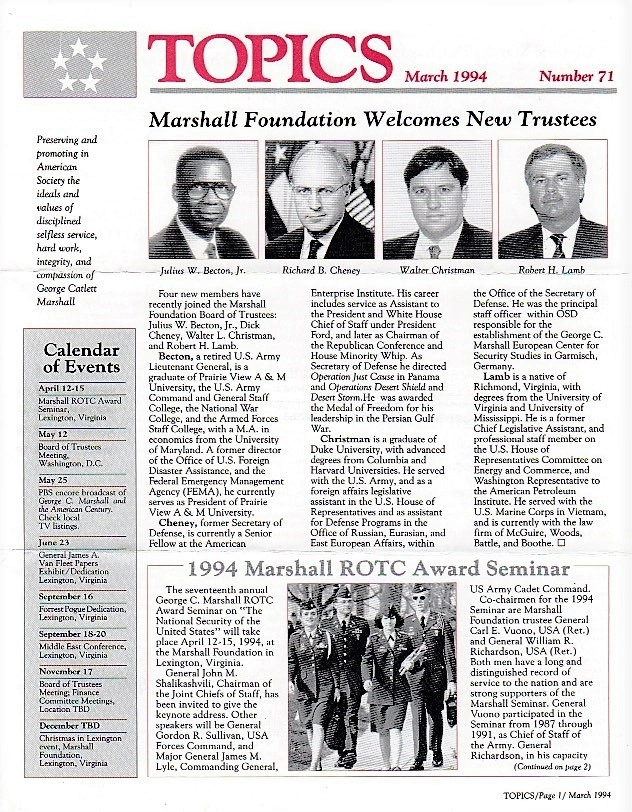
In Lexington, Virginia, the George C. Marshall Foundation preserves Marshall’s papers. In March 1994 the Foundation named four new trustees. Among them were Dick Cheney, who had authorized the Marshall Center, and Walter Christman, who had proposed it.
The trusteeship also brought Walter together with General Gordon Sullivan. One evening Walter took his fellow trustee to meet Alvin and Heidi Toffler in their hotel room. He asked what a Marshall Plan for the Information Age might look like. The postwar plan had helped people rebuild factories, farms and trade. What could Americans and Europeans now build together as knowledge crossed their borders?
The White House conference in Washington
National Security Advisor Anthony Lake appointed Walter Director of the Marshall Legacy Initiative. Detailed from the Pentagon to the National Security Council, he worked with Morton H. Halperin to bring public officials, educators and civic leaders together. He recruited five former secretaries of defense for the symposium. The White House and George Washington University’s Elliott School organized it with support from the Defense Department and the National Guard.
On November 13, 1995, President Bill Clinton wrote directly to Walter, inviting him to “The Marshall Legacy: Partnerships for the Future,” scheduled for January 8–12. The President asked how Americans could widen the ties that governors and National Guard units were already building with Europe’s new democracies.
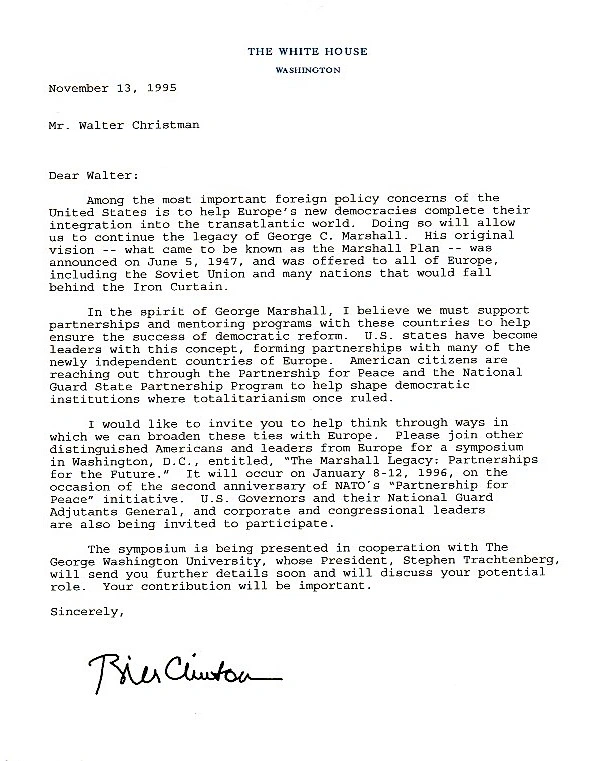
Read the text of President Clinton’s letter
THE WHITE HOUSE
WASHINGTON
November 13, 1995
Mr. Walter Christman
Dear Walter:
Among the most important foreign policy concerns of the United States is to help Europe's new democracies complete their integration into the transatlantic world. Doing so will allow us to continue the legacy of George C. Marshall. His original vision -- what came to be known as the Marshall Plan -- was announced on June 5, 1947, and was offered to all of Europe, including the Soviet Union and many nations that would fall behind the Iron Curtain.
In the spirit of George Marshall, I believe we must support partnerships and mentoring programs with these countries to help ensure the success of democratic reform. U.S. states have become leaders with this concept, forming partnerships with many of the newly independent countries of Europe. American citizens are reaching out through the Partnership for Peace and the National Guard State Partnership Program to help shape democratic institutions where totalitarianism once ruled.
I would like to invite you to help think through ways in which we can broaden these ties with Europe. Please join other distinguished Americans and leaders from Europe for a symposium in Washington, D.C., entitled, "The Marshall Legacy: Partnerships for the Future." It will occur on January 8-12, 1996, on the occasion of the second anniversary of NATO's "Partnership for Peace" initiative. U.S. Governors and their National Guard Adjutants General, and corporate and congressional leaders are also being invited to participate.
The symposium is being presented in cooperation with The George Washington University, whose President, Stephen Trachtenberg, will send you further details soon and will discuss your potential role. Your contribution will be important.
Sincerely,
Bill Clinton
What happened at the Mayflower
Washington was in a blizzard when Lake delivered the opening address at the Mayflower Hotel on January 8, 1996. American and Russian troops who had recently exercised together in Kansas were now helping Bosnia rebuild. He pointed to state partnerships, including Georgia’s ties with its namesake in the Caucasus, and asked the participants to make contacts they could use when they got home.
The conference brought together 450 civilian and military participants from 43 countries. Several million dollars in Partnership for Peace funding went to its State Partnership Program, and the Secretary of Defense issued policy guidance for future cooperation. Constantine Menges brought the conference proceedings into print. For Walter, one result was seeing how the new Marshall Center, the Guard’s state partnerships and Switzerland’s growing information network could serve the same people. He took that idea into the work on training and education that reached NATO’s Washington summit three years later.
Sources and recollections
- Walter L. Christman, The Apocalypse of Assumptions (The Age of Convergence, Book I), chapter 14, p. 211.
- Walter L. Christman, Toward a Global Partnership (Geneva dissertation, 2007), chapter 4, p. 112 and notes 154 and 156.
- Making Partners of Adversaries, chapter 5, on the conference and its organizers.
- Topics, George C. Marshall Foundation, no. 71, March 1994, “Marshall Foundation Welcomes New Trustees.”
- President William J. Clinton to Walter Christman, November 13, 1995. Walter’s Duke ROTC collection.